Shropshire’s parks and nature sites lift our spirits. Neil Thomas meets some of the dedicated team who care for them.
Shropshire boasts some of the loveliest countryside in the UK. Rolling hills, verdant meadows, delightful waterways – including a majestic river and our very own lake district – and a network of footpaths and bridleways make our county a magnet for those in search of bucolic bliss.
It is widely acknowledged that contact with nature and rural tranquillity are beneficial to mental health and wellbeing. Shropshire is clearly the place to be for a happier life!
Nature, though, needs tender loving care to be at its best – indeed, to survive. The parkland, the delightful open spaces, the woods and riverside walks, require regular maintenance and development if they are to remain there for us to enjoy.
Behind the scenes, round-the-clock and in all weathers, works a small, dedicated team of countryside rangers – specialists in their field – whose efforts ensure the beauty spots and ecological treasures on our doorstep survive for us and generations to come.
Shropshire Council Parks and Countryside Team cares for 28 parks and open spaces across Shropshire. It is a huge task, covering England’s biggest inland county (nearly 1,350 square miles) with its varied geology and topography. Sites range from meres and mosses in the relatively flat landscape of north Shropshire to hills and valleys in the south.
It is vital work, for these sites are widely cherished, hosting an estimated 1.16million visitors a year.
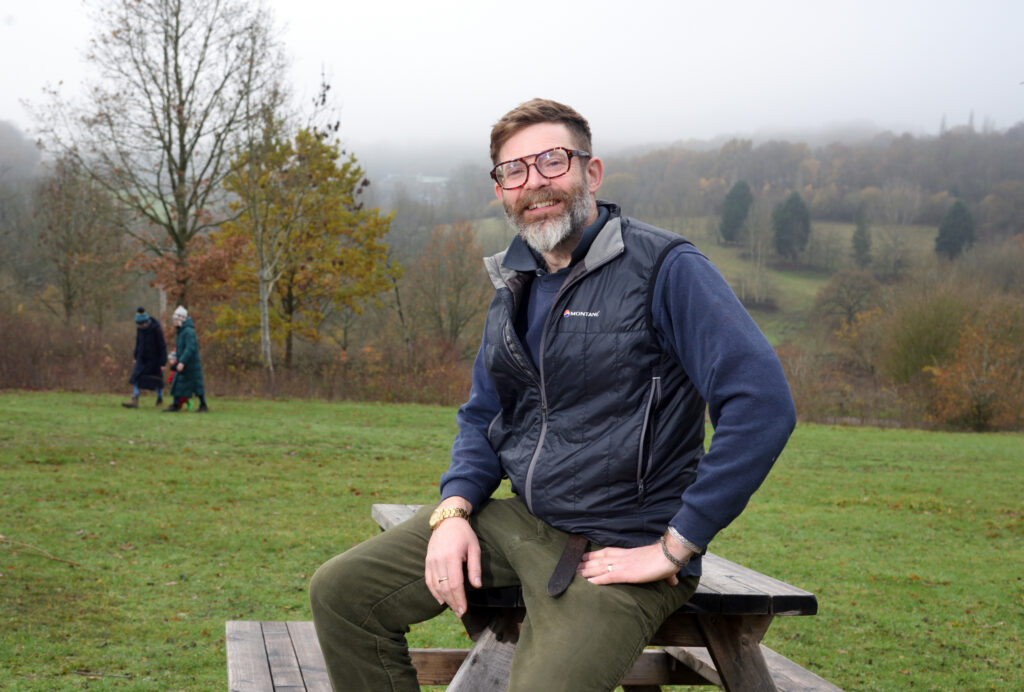
Edward ‘Ed’ Andrews is the county’s Parks and Countryside Sites Manager, leading a team of three rangers – Guy Border, Mike Simms and Lee Fraser – plus team co-ordinator, Susie Comaish. If a stretched police force can be dubbed the ‘thin blue line’, then Ed and his team can justifiably be seen as the ‘thin green line’.
The team’s two busiest sites are Severn Valley Country Park near Bridgnorth and the Mere at Ellesmere. These sites have facilities such as cafes, toilets, play areas, easily accessible paths, benches and picnic areas. They also host events such as Park Run, toddler nature sessions and school visits.
“Other sites are smaller and form a vital part of the green infrastructure of our towns and villages,” Ed explains. “They are places where people can walk the dog and gain the health benefits, both mental and physical, of access to green spaces.”
The team also cares for ecologically sensitive sites such as Brown Moss Nature Reserve near Whitchurch. Brown Moss has many designations – SSSI (Site of Special Scientific Interest), Special Area of Conservation and, notably, a Ramsar site (deemed globally important under the wetlands convention agreed by the UNESCO international environmental treaty signed at Ramsar, Iran in 1971). Brown Moss is heathland, wetland and quaking bog, home to 200 species of plant and 30 species of breeding birds. “Efforts need to be made to protect the site from erosion,” Ed says.
There are other sites that you may not be aware of but are certainly worth a visit. Corbett Wood, near Wem in north Shropshire, is perched on the slopes of Grinshill’s sandstone ridge. It offers spectacular views, a leafy canopy and former quarry faces, where internationally important fossils have been discovered. There’s free parking too!
Also in north Shropshire, there is a delightful walk from Ellesmere to Colemere, linking two of the county’s most picturesque meres.
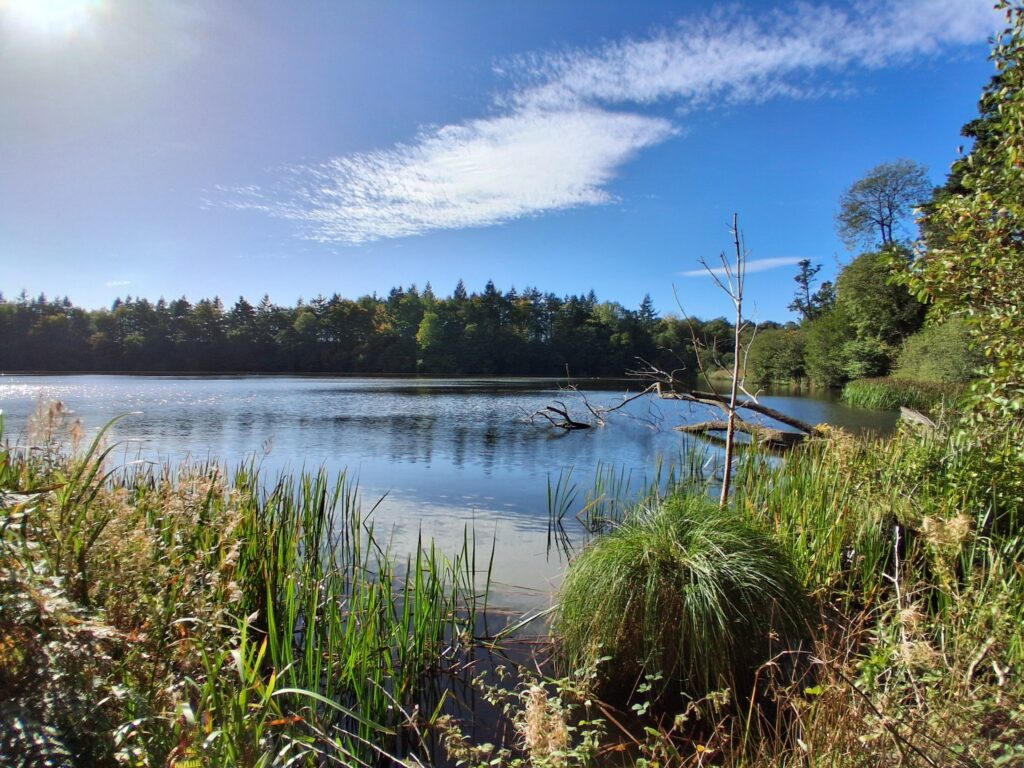
Snailbeach, in south Shropshire, is home to one of the best-preserved lead mines in western Europe.
“This site is a valuable portal into a forgotten world of industry,” Ed explains. “Shropshire Mines Trust offers the unique opportunity to explore the underground workings or you could continue your walk onto the Stiperstones National Nature Reserve.”
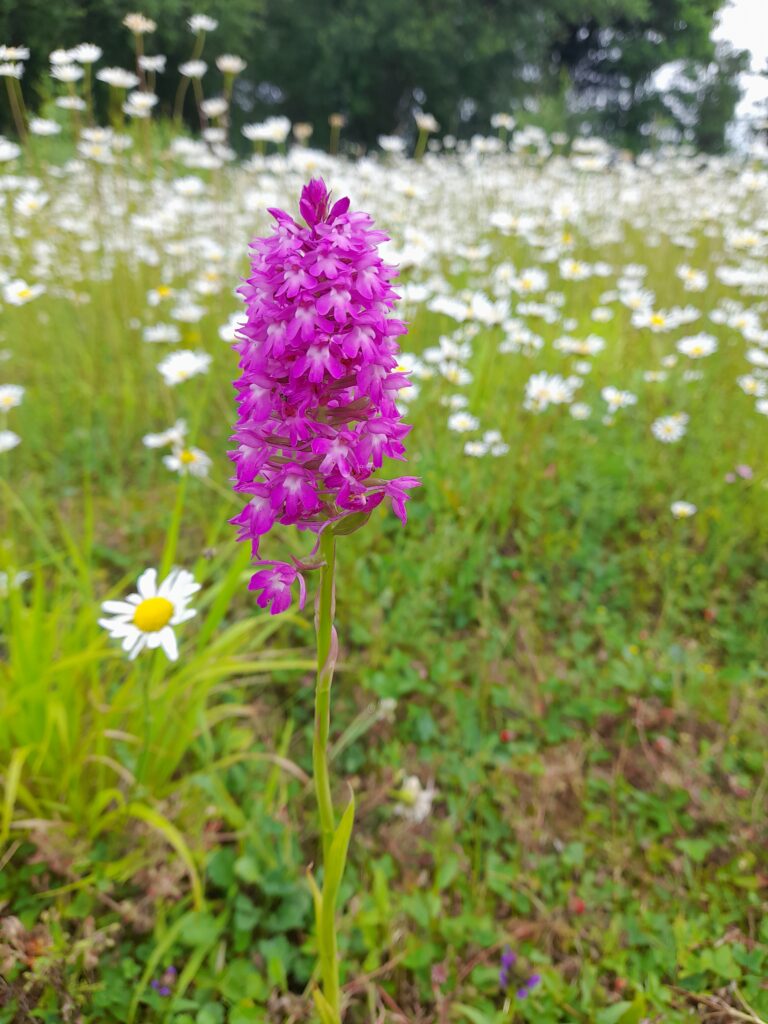
Oswestry Racecourse, with its stunning views over Shropshire and the Welsh borders, offers a colourful slice of history. Here people socialised and raced horses in the 18th and early 19th centuries. This 54-acre common may not have seen a horse race since 1848, but the outline of its colourful past remains. Now a popular place for country walks and picnics – Offa’s Dyke path runs through the site – it has become a habitat for many important species, including orchids.
Lyth Hill, on the outskirts of Shrewsbury, offers some of the best panoramic views in the county, taking in The Wrekin, Wenlock Edge and the Stiperstones. Its areas of woodland, scrub, and open grassland provide a treasure of wildlife.
The Shropshire Way passes through Lyth Hill as does The Humphrey Kynaston Way long-distance bridleway, meaning the site is a magnet for walkers, runners and riders.
Lyth Hill also has a significant literary connection. Poet and novelist Mary Webb (1881-1927) loved the place and made her home there at Spring Cottage. Noted for her vivid descriptions of nature, Webb was doubtless inspired by Lyth Hill’s spectacular landscape. Largely unrecognised in her lifetime, she achieved posthumous fame when in 1928 Prime Minister Stanley Baldwin called her a “neglected genius”. Sales of her work soared in the 1930s and there have been notable film adaptations of Gone to Earth (1950) and Precious Bane (1989).
This is just a taste of the environmental, cultural and historical treasures that Ed and his team have in their care. They face many challenges.
“Funding is a constant challenge. Years of austerity have left budgets increasingly stretched,” Ed explains. “The team is much smaller than when I joined 23 years ago and we manage a huge area of land.
“Habitats are becoming fragmented through development and intensive land management. Climate change is also adding pressure, for instance in the increased prevalence of tree diseases such as ash dieback.”
These clouds come, though, with an impressive silver lining. Ed’s small team is supported by an army of volunteer helpers. Indeed, Ed has calculated that total volunteer hours in a typical year amount to around 160,000 – collectively over 18 years’ worth of free labour annually.
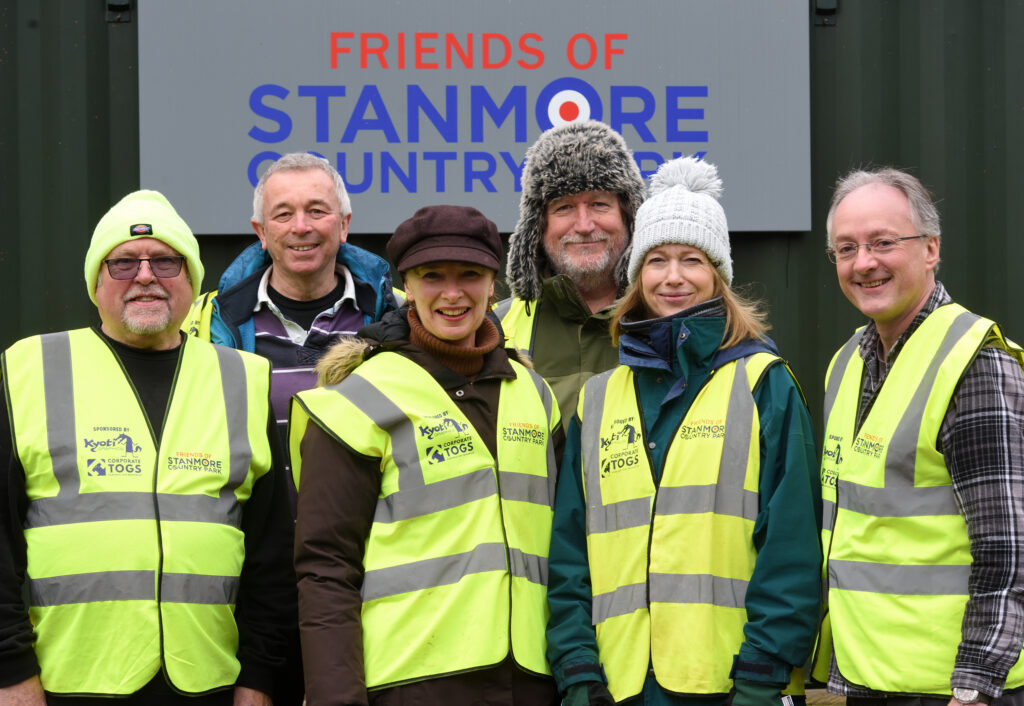
It is the perfect moment to move on to Stanmore Country Park, on the outskirts of Bridgnorth, where we meet members of the volunteer Friends group, who help to maintain and enhance the 100-acre site. A couple of days a month, Friends of Stanmore (FOS) working parties will be out in the woodland with loppers, saws, clippers and other sundry landscaping and gardening equipment.
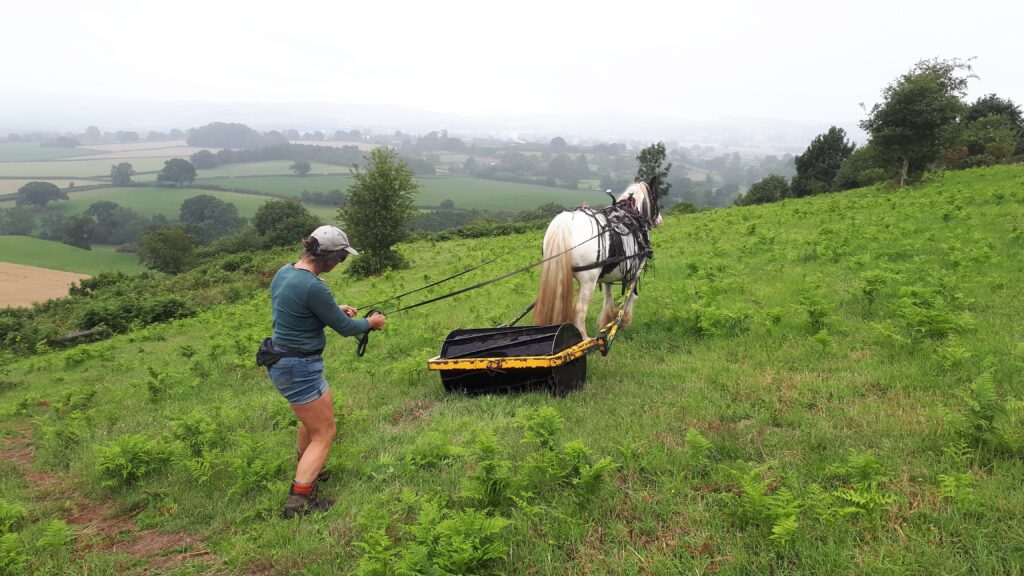
For instance, Darren Hodson is king of the leaf-blowers, a dab hand at clearing the network of pathways of the carpets of dead leaves that cover them in autumn and winter and, when greasy, can be hazardous under foot. Like much of what the volunteers undertake, it is physically intense labour involving strapping on a petrol-driven backpack.
“Eventually I’ll end up walking with one shoulder higher than the other,” he jokes.
Darren, as a member of Worfield and Rudge Parish Council, can also give the Friends a voice in the wider community. Indeed, the Friends has received two grants of £500 from the council – though Darren, as a responsible councillor, declared an interest and withdrew from the discussion and vote. The money went towards spring flowering plants and the cost of creating a Queen’s Platinum Jubilee Garden, celebrating the late Elizabeth II’s 70 years on the throne in 2022. It is one of several themed features in the park, of which more later.
Council chairman Elaine Aldridge says of Stanmore: “It is a tremendous amenity which we are proud to have within our parish. It offers residents a fantastic green space and the council will try to support it whenever possible. We’re very grateful to the Friends of Stanmore for their continued hard work to ensure the park remains such a welcome addition to the parish. We thank them for their dedication on behalf of all residents.”
Friends Chairman is Andy Howard. A geologist and lecturer by profession, he brings a range of skills to the role, including being something of an expert in sourcing and applying for the grants which are essential to funding the Friends’ work.
These have included £8,000 from Tesco’s Bags of Help community fund, used to upgrade paths, plant a community orchard and row of black poplars and design and install six information panels that celebrate the park’s history as an RAF camp; £1,015 from the Co-op ‘Community Fund’ to purchase seating where people can meet and chat; £600 from Shropshire Town and Rural Housing (STAR) Community Chest fund and £500 from waste firm Veolia’s Make a Difference community fund, used to pay for five owl, eight bat and 30 bird boxes across the park. A recent survey recorded an 80 per cent occupancy.
In 2022, FOS was granted more than £72,000 from Severn Trent’s Community Fund and Shropshire Council to enhance bio-diversity, improve access for those with impaired mobility and create and install a Family Discovery Art Trail, aimed at engaging children – the park’s future custodians.
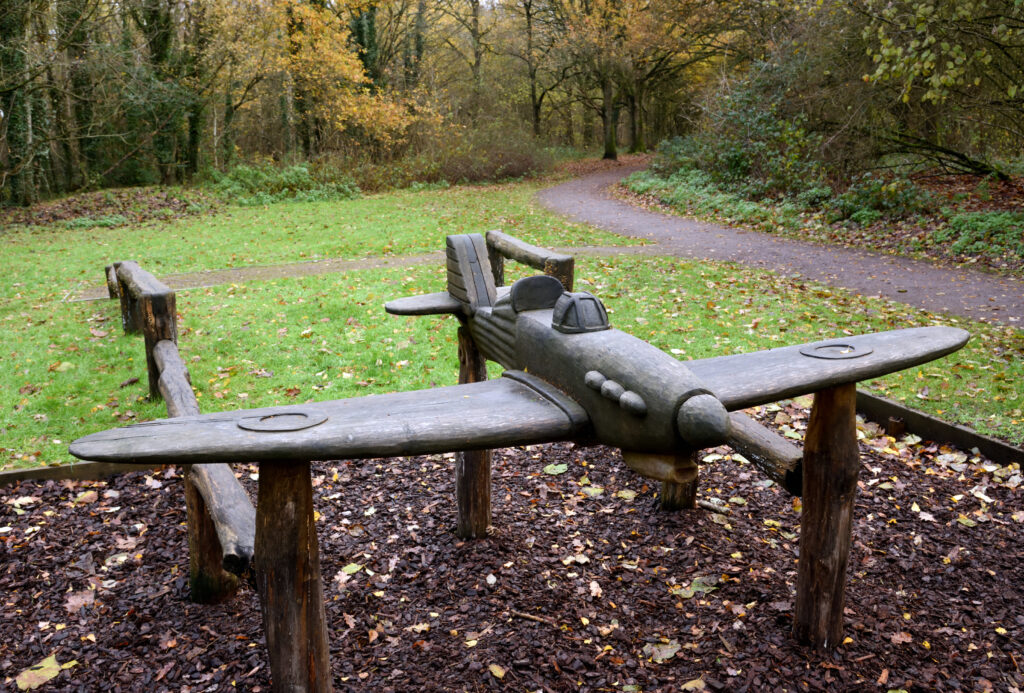
The trail features sculptures created by artist Anthony Hammond, that interpret the history and natural wonder of the park. It includes a carved oak Hawker Hurricane plane and two balance beams. There is a splayed tree known locally as the Octopus with carved oak props – one shows a shipwreck with a sea monster, the Kraken, another picks out different leaf motifs and several props illustrate little fairy houses to honour local stories.
The Butterfly Bench with carved oak back represents the lifecycle – from egg to caterpillar to chrysalis to adult – of the White Letter Hairstreak butterfly, a critically endangered species found on site. A carved totem pole interprets the wildlife that can be found within an orchard. There is a carved oak and hazel wildlife bridge, whose abutments show the wildlife that can be found in and around natural ponds. Another bench has an oversized clenched oak back, carved by hand to represent the Violet Helleborine, a woodland orchid found on site during summer months.
Created to commemorate the Coronation of King Charles, the elegant Listening Throne includes a depiction of the king’s crown and representatives of the four nations of the UK. It is carved from wood sourced from the park and designed to encourage contemplative listening of the surrounding sounds.
Friends of Stanmore come from a variety of backgrounds but have one thing in common, the desire to contribute to the community to make a difference.
Phil Swatman lives next door to the park and joined the group a couple of years ago. “I retired three years ago and was looking for something to get involved in and someone suggested this. It’s very rewarding.”
The chance to pursue new interests, pick up different skills, is part of it. Lucy Hockenhull and husband Rob, for instance, run a signwriting business. For FOS, Lucy carried out an extensive butterfly survey on the site.
“I found it fascinating, tracking the different species and a complete change of pace from the day job.”
Julie Mowbray, who travels from Stourbridge, a dozen miles away, to take part, is accountant. “I love the complete contrast of practical work at the park with sitting at a desk.
“I had moved to the area and was looking to get involved in the community. I visited Severn Valley Country Park for a day out and someone mentioned the Friends of Stanmore and it seemed a great thing to get involved in.”
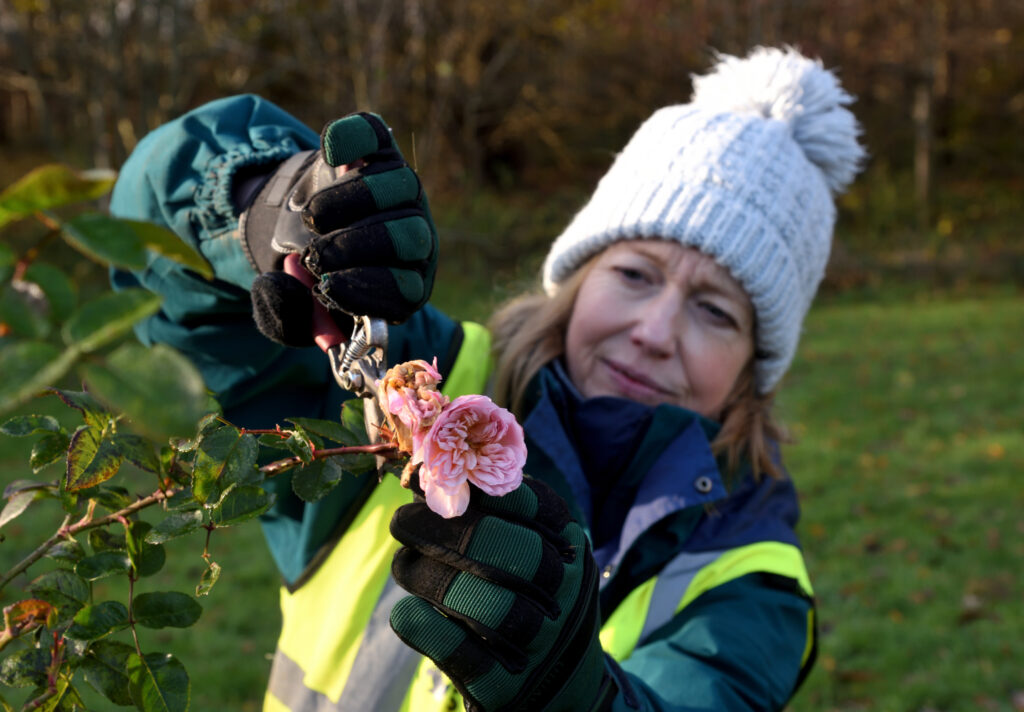
Nick Trott, who spent 30 years working in aquaculture, was one of the founder members of the group, which launched in 2012.
“Our goal is to improve the site’s biodiversity, protecting and encouraging natural habitats while making it as accessible as possible for people to enjoy,” he explains. “It’s a fine balance. The wide, straight, well-maintained pathways allow easy use for visitors while ensuring that nature away from the paths is largely undisturbed and so allowed to flourish.”
Ongoing work by the Friends includes woodland and grassland management as well as general maintenance. Tasks undertaken by FOS working parties include tree coppicing, strimming undergrowth, glade creation to improve biodiversity, hay raking and strewing to maintain grasslands, wildflower spaces preparation, hedgerow and fencing maintenance, path improvements, bench maintenance, bird box recording, cleaning and repair and litter picking plus bin installation and repair.
“As a group we get on very well. There’s a real sense of teamwork. We work hard here but enjoy what we do,” Andy says. Volunteers get the chance to meet people, learn new skills, improve fitness and well-being and help to maintain and protect a lovely green space for current and future generations to enjoy.
“Training and equipment are provided, and it’s up to each member how much time they commit,” Andy adds.
The park is on the former RAF Bridgnorth base, which opened in 1939 and closed in 1963. Though never an operational airfield, it was an important basic training camp through which thousands of recruits passed.
Few traces remain, save for the old cookhouse chimney preserved as a war memorial on the Russell Close side of the park and the old concrete roads on the Hobbins side. The memorial was restored in 2013 and now includes a plaque honouring the former RAF personnel. The current car park is on one of the camp’s four parade grounds. FOS have created a series of six information panels about the history. Because of these past links, teams from RAF Cosford are involved in some of the Friends’ work.
A place once alive with the energetic drills and rugged training of the ‘boys in blue’, is now a gentler home to a wide variety of insects, reptiles, amphibians, small mammals, including bats, and a diverse mix of birds including raptors, whose habitats are the park’s mixed woodland, open grassland, including wildflower meadows, and several small ponds. In 2009, several nationally scarce species of hoverfly were found making use of dead wood on site.
FOS estimate 100,000 trees are growing including oak, beech, birch, elm, goat willow, hawthorn, hazel, maple and silver birch. Whilst much of the woodland is around 40 years old, the site does include some older and more established trees including oak, beech and sweet chestnut.
In addition, the FOS have planted a community orchard with around 20 fruit trees, promoting varieties with historical connections to Shropshire. Several large black poplar trees, probably planted in the days of the RAF base, used to grow in the park, so in 2016 a new avenue of these trees was planted. This broadleaf deciduous tree is native to Britain and can live for up to 200 years. However, despite this longevity, black poplars are often considered one of our most endangered native trees.
Black poplar is an important food source for the caterpillars of many moths, whilst the catkins provide an early supply of nectar and pollen for bees and other insects.
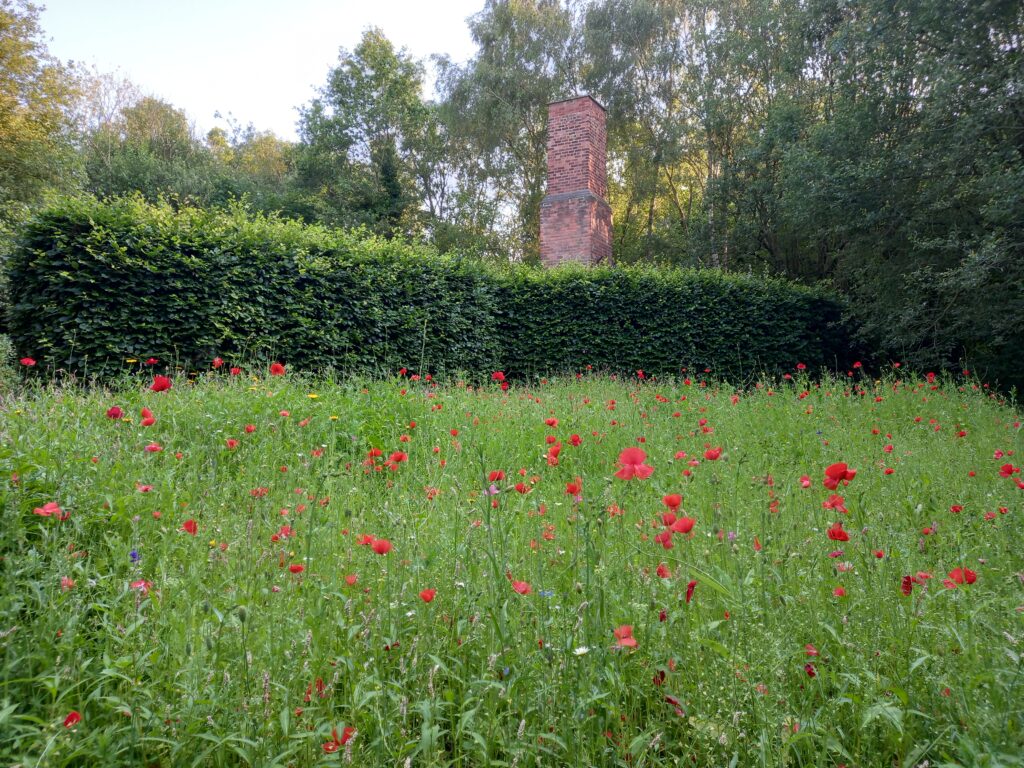
Next to the RAF Memorial is a wildflower area planted in 2016. It is dominated by poppies, the traditional flower of remembrance, together with other cornfield species including corn chamomile and cornflower. Together, these flowers provide important food sources for bees, butterflies and other pollinating insects.
Since 2019, the FOS have been awarded the Green Flag Community Award, global recognition for well managed parks and green spaces. Sites must be welcoming, healthy, safe and secure, be well maintained and clean, demonstrate good environmental management, and community involvement – and be unique. The site is judged annually.
It is interesting to note that since the Friends group was established, there has been a marked decline in incidents of anti-social behaviour and vandalism in the park. Visitors see a tidy, well-maintained site with a diversity of trees, flowers, plants and birdlife, with imaginative, beautifully carved sculptures and other eye-catching features.
The extent to which the park is now cherished by local people was illustrated by the 9,000 signatures backing a successful campaign to oppose plans to bulldoze a swathe of the site to make way for development.
The regeneration of former working sites like Stanmore to green spaces for public enjoyment is not an uncommon theme. Indeed, Severn Valley Country Park, barely a dozen miles away, was once a colliery employing, at its height, more than 1,000 people producing up to 300,000 tons of coal a year. The mine closed in 1969, work started to reclaim the site in the mid-1980s and the 126-acre park with woodland, meadows and riverside banks with views over the Severn, opened in 1992. It, too, has a Green Flag award.
“I’m always amazed at how passionate people are about what we have here at Severn Valley Country Park,” Ed Andrews reflects. “That fact that it has been developed on the site of an old mine plays a part in that. There are local people who have a strong connection with it because of family members who were mineworkers here. It can be a place of reflection for some.
“It is a wonderful example of how we can help nature to reclaim disused industrial sites and turn them, with good management and imaginative landscaping, into places of beauty.”
Ed, who lives in Bridgnorth with his young family, has loved nature since he was a child.
“Growing up in Kidderminster, I spent time exploring the Wyre Forest and would often go for family trips into the country, which was quite formative.
“I used to collect bugs and study them to see what made them tick. I was friends with a neighbour – we’d be about nine or 10 – and I remember his dad had one of those cabinets in his garage with small drawers for screws. We thought it would be a good idea to empty out all the screws and keep our bugs in there. Needless to say, his dad went crackers,” Ed recalls, chuckling at the memory.
He graduated in Environmental Biology at Swansea University followed by attaining a Masters in Biological Recording.
In his spare time, he volunteered at Severn Valley Country Park and, so impressed were bosses by his knowledge and passion that when an opening arose, he was offered the post.
“I was 22 and the rest, as they say, is history. Here we are, 23 years later and I’m still loving what I do.”
Readers of What’s What will doubtless recognise Ed from his regular Wildlife Column which is always packed with fascinating facts shared in stylish, colourfully descriptive prose.
“I’ve always loved writing. It’s a real joy to contribute the wildlife diary. In fact, I’m writing a book about nature and my travels exploring it. I’ve got about 80,000 words at the moment and have one or two ideas about contacting particular publishers who specialise in my subject.”
Ed loves sharing his knowledge of the natural world and inspiring us with its importance to us all.
“These sites we have in Shropshire make such a positive contribution to everyday life. They are the green lungs of our towns and villages, mitigating the impact of climate change. They are places for all ages to come together, combating social isolation. In these places, children can learn and discover so much that is exciting about the world around them. The benefits for physical and mental health are tangible and proven, in the long run reducing the burden on the NHS.
“We all need nature’s beauty in our lives. It raises the spirits. And in Shropshire, it’s all around us.”
For information about becoming a volunteer, please contact a Shropshire ranger on 01746 781192. For more general information please visit Shropshire.gov.uk/outdoor-partnerships